Type a question into ChatGPT, Perplexity, or Google today, and there’s a good chance you’ll get a complete answer without ever clicking a link. That’s the new default. AI tools are answering queries directly, pulling from (and citing) content across the web to build their responses.
But if AI is the one answering, how do you make sure it’s answering with your content? This guide breaks down how LLMs select and cite sources, and what you can do to make sure your brand shows up in the answer.
Why AI Search Optimization Matters for Brand Visibility
Search is no longer just about ranking in a list of blue links. It’s about being cited, quoted, and recommended inside an AI-generated answer that a user may never click through from at all.
This shift has a name: AI search optimization, also known as Generative Engine Optimization (GEO). And if you’re wondering whether it deserves a spot on your marketing roadmap, the answer is yes.
While Traditional SEO optimizes for ranking in search engine results pages (SERPs), AI search optimization optimizes for citation within AI-generated answers, where there might only be three or four sources referenced at all.
As tools like ChatGPT, Perplexity, and Google AI Overviews answer queries directly on the page, click-through rates to traditional websites are dropping. If your content isn’t built to be cited by these systems, your brand risks becoming invisible in the exact moments when potential customers are looking for answers.
How AI Search Engines Select and Cite Content
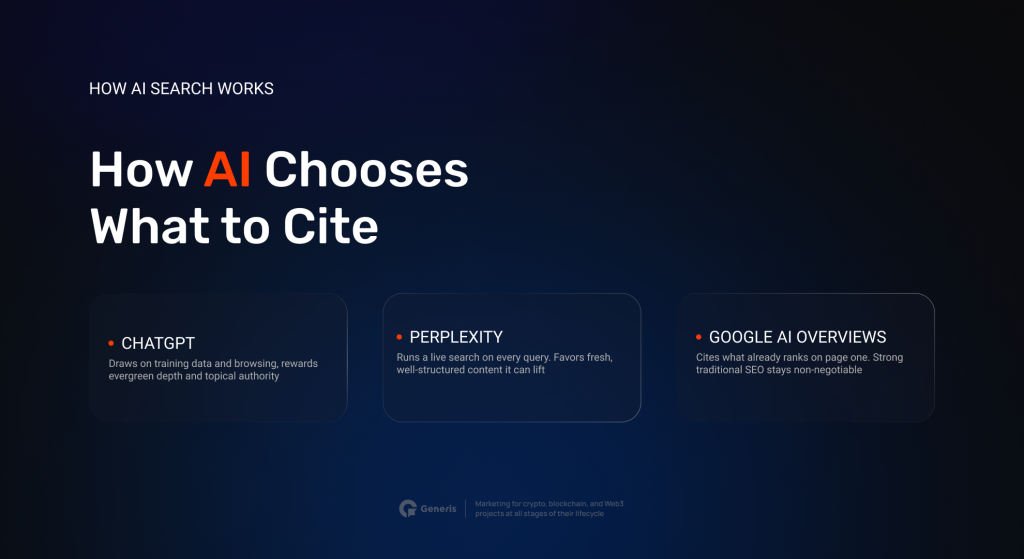
Different AI tools use different methods to find and cite sources, which means a one-size-fits-all approach to SEO for AI search is ineffective. Each platform pulls from different data sources, applies different citation logic, and rewards different content signals. Understanding these mechanics is the foundation for any effective optimization strategy.
How ChatGPT and SearchGPT Process Content
ChatGPT’s core model primarily draws from its training data: a large but static snapshot of information collected up to a specific cutoff date. This means it has no awareness of anything published after that point unless it’s using a browsing-enabled mode.
SearchGPT, OpenAI’s browsing-enabled search experience, works differently. It searches the live web in real time, similar to how a traditional search engine crawls and indexes fresh content. The core distinction to remember is this: static training data rewards evergreen authority, while live retrieval rewards freshness and real-time relevance.
How Perplexity Searches and Summarizes in Real Time
Perplexity operates on an entirely live search model: every query triggers a real-time web search. It pulls from multiple sources simultaneously, synthesizes the information into a single coherent answer, and includes numbered inline citations that link directly back to original source pages.
It heavily favors fresh, well-structured, and up-to-date content, a good example of how to optimize for AI search when freshness is the dominant ranking signal.
How Google AI Overviews Pull from Search Results
Google AI Overviews primarily cite pages that are already ranking on the first page of Google’s search results for a given query. This means that strong, traditional SEO remains the essential foundation for how to optimize for AI Overviews and earn citations within them.
| AI Tool | Data Source | Citation Style | Key Ranking Factor |
| ChatGPT | Training data + browsing | Inline links (when browsing) | Topical authority |
| Perplexity | Live web search | Numbered inline citations | Freshness + structure |
| Google AI Overviews | Google Search index | Source cards | Page-one ranking |
What Content AI Tools Cite Most
To earn AI citations, content must possess certain qualitative characteristics that make it citation-worthy. These patterns reflect genuine best practices for optimizing content for AI search engines, focused on depth, authority, and structure rather than simple keyword metrics.
Content Length and Depth
AI models consistently favor longer, more comprehensive content that thoroughly covers a topic from multiple angles rather than skimming the surface. Thin content (pages that touch on a topic without truly answering the underlying question) rarely gets cited, because it simply doesn’t contain enough substantive information to extract.
Source Authority and Domain Reputation
AI tools tend to cite established, trusted domains with a proven reputation in their subject area. This is where E-E-A-T (Experience, Expertise, Authoritativeness, and Trustworthiness) comes back into play: the same signals Google has used for years to evaluate quality now double as trust signals for AI citation models.
Content Structure and Formatting Patterns
AI models can more easily extract information from well-structured content. Bullet points, numbered lists, tables, and clear, descriptive headings are high-value formats. An answer-first structure, where the direct answer is provided upfront, is one of the most effective AI search optimization techniques available.
Visual and Multimodal Elements
Images, diagrams, and video content can meaningfully increase the likelihood of citations, particularly for Google AI Overviews, which frequently include visual elements alongside text. Always pair visuals with descriptive alt text and captions. They provide AI crawlers with the context they need to understand and reference visual content appropriately.
How to Optimize Content for ChatGPT and SearchGPT
Optimizing for ChatGPT and SearchGPT requires playing to their specific strengths: deep training-data recall and real-time browsing capability, respectively.
1. Create comprehensive evergreen content
ChatGPT’s training data rewards authoritative, foundational content that stays relevant well beyond its publish date. Focus on building definitive resources, the kind of article someone bookmarks because it fully answers their question, today and a year from now.
2. Build topical authority across related subjects
Topical authority refers to how deeply your website demonstrates expertise on a given subject. Building content clusters (groups of interlinked articles that thoroughly cover a topic and its subtopics) signals genuine subject-matter depth to AI systems, increasing the odds your domain gets treated as a go-to authority.
3. Ensure content is publicly accessible and crawlable
AI can’t cite what it can’t access. Double-check that key pages aren’t accidentally blocked by your robots.txt file, gated behind a login wall, or otherwise hidden from crawlers. This sounds basic, but it’s one of the most common reasons high-quality content never gets surfaced.
4. Use clear definitions and factual statements
Write direct, definitive statements that an AI model can quote cleanly. Hedging language, ambiguity, and heavily subjective opinions are much less likely to be extracted, since AI models are optimizing for clarity and confidence in the answers they generate.
How to Optimize Content for Perplexity AI
These strategies are tailored for optimizing for AI search on Perplexity’s live search and real-time citation model, which prioritizes freshness and scannability.
1. Target conversational and question-based queries
Structure content around the way people actually phrase questions in natural language. It will align your content with how users are actually prompting these tools.
2. Provide direct answers in the first paragraph
Lead with an answer-first structure: state the direct answer to the target question within the first paragraph, then use the rest of the article to build out supporting detail, nuance, and context. Perplexity tends to pull heavily from this opening material when constructing its synthesized answers.
3. Structure content with scannable formatting
Bullet points, numbered lists, and short, digestible paragraphs make an enormous difference here. Perplexity is particularly effective at lifting well-formatted lists directly into its generated answers, so the easier you make your content to scan, the easier it is to cite.
4. Include recent data and updated information
Since Perplexity’s model is built around live search, freshness is a genuine ranking factor. Regularly refresh key pages with updated statistics, new developments, and current examples. Adding a visible “last updated” date is a simple, effective signal of ongoing relevance.
How to Optimize for Google AI Overviews
Google AI Overviews are the one AI search surface where traditional SEO isn’t just helpful, it’s non-negotiable.
1. Rank on page one for target queries
Google AI Overviews almost exclusively cite content from pages ranking on the first page of search results. Therefore, SEO fundamentals (keyword research, quality content, and backlink building) remain essential to any strategy to optimize site for AI search algorithms.
2. Match search intent precisely
Your content needs to directly and comprehensively answer what the searcher is actually looking for. Even a page that ranks well can be passed over in favor of an AI Overview citation if its content doesn’t precisely align with user intent.
3. Use structured data and schema markup
Schema markup is code added to your site that helps search engines understand your content’s meaning and structure. Implementing a schema for FAQs, how-to steps, and article metadata makes it significantly easier for Google to parse and extract your content for an AI Overview.
4. Optimize existing content for featured snippets
The formatting that wins featured snippets overlaps heavily with what earns AI Overview citations. Focus on clear, concise answers in dedicated sections, supported by lists and logically structured headings.
How to Structure Content for AI Extraction
Regardless of which platform you’re optimizing for, certain structural techniques consistently make content easier for AI models to extract and cite.
Lead with Clear Answers Before Supporting Details
Place the direct answer to a question or the main point of a section within the first one to two sentences. The supporting context, examples, and deeper explanation should follow this initial answer. This paragraph-level approach is the essence of passage optimization for AI: each section should stand on its own as a complete, extractable unit.
Use Bullet Points and Numbered Lists
AI models are built to prioritize structured, easily parsed data. Lists are among the most frequently quoted formats in AI-generated answers, making them one of the highest-leverage formatting tools available to you.
Add Comparison Tables for Evaluation Queries
For “best,” “vs.,” or “alternative”-style queries, comparison tables are especially effective. AI systems can cleanly extract tabular data to present side-by-side comparisons, which is exactly the kind of information users are looking for in evaluation-stage searches.
Include Summaries and Key Takeaways
Adding “TL;DR” sections or “Key Takeaways” boxes gives AI models a concise, pre-digested summary that’s ideal for extraction and often becomes the backbone of a generated answer.
Create FAQ Sections with Specific Questions
FAQ formatting is remarkably well-suited to AI citation models. Structure these sections around clear, direct “What,” “How,” and “Why” questions, followed by concise, confident answers.
Technical SEO Factors That Improve AI Search Visibility
Even the best-written content needs a solid technical foundation to be properly accessed, crawled, and understood by AI systems.
Page Experience and Core Web Vitals
Fast-loading, mobile-friendly pages with strong overall user experience are favored by both traditional search engines and AI crawlers. Poor Core Web Vitals performance can quietly undermine your visibility across both channels.
Crawlability and Indexation Settings
Regularly verify that your robots.txt file and meta robots tags aren’t unintentionally blocking AI crawlers. Keep your sitemap current and properly submitted. Small technical oversights here can silently exclude your best content from consideration.
Structured Data and Schema Markup Implementation
Prioritize schema types that are particularly valuable for AI extraction, such as FAQPage, HowTo, and Article schema. These give search engines and AI models explicit, machine-readable clues about your content’s meaning and format.
Mobile Optimization and Accessibility
AI tools tend to favor mobile-friendly, accessible content. A responsive design, clean HTML, and a properly structured heading hierarchy (H1, H2, H3) improve both machine readability and the human experience of your site.
Best AI Search Optimization Tools for Tracking Performance
As AI search optimization matures, an entire category of supporting tools has emerged to help teams monitor and refine their performance.
Citation and Brand Mention Tracking Platforms
These are tools that monitor when and where AI tools like Perplexity or Google AI Overviews cite your brand or link to your content, giving you direct insight into your AI search performance. Some of these platforms are increasingly marketed as AI search optimization tools for social media, too, since brand mentions in AI answers and social conversations are starting to overlap.
AI Content Analysis and Optimization Tools
These platforms analyze your content’s structure, readability, and formatting, then recommend specific improvements to make it more “AI-friendly” and easier for models to extract information from.
Traditional SEO Tools with AI Search Features
Many established SEO platforms are now adding AI search visibility tracking as a built-in feature. These tools can help you monitor which of your ranking keywords are triggering AI Overviews, and whether your content is actually being featured within them.
- Brand monitoring tools track mentions across AI platforms
- Content optimization tools analyze structure and readability
- Rank tracking tools monitor traditional rankings that feed AI Overviews
How to Measure AI Search Optimization Results
Measuring success in AI search requires expanding beyond the metrics traditional SEO has trained marketers to rely on.
Traffic Attribution from AI Referrals
Within your analytics platform, learn to identify and segment traffic from AI sources such as ChatGPT, Perplexity, and Google AI Overviews. This helps quantify exactly how much traffic these channels are actually driving to your site.
Brand Mention and Citation Volume
Track how often your brand name or content appears in AI-generated answers, even without a direct click. This measures your share of voice and visibility within the AI ecosystem, and it’s the clearest available answer to does AI content optimization improve search visibility for your specific brand.
Engagement and Conversion Metrics
Assess whether traffic referred from AI sources engages and converts differently from traditional organic search traffic. This is how you tie AI search optimization back to real business value.
AI Search Optimization Strategies for Web3 and Crypto Projects
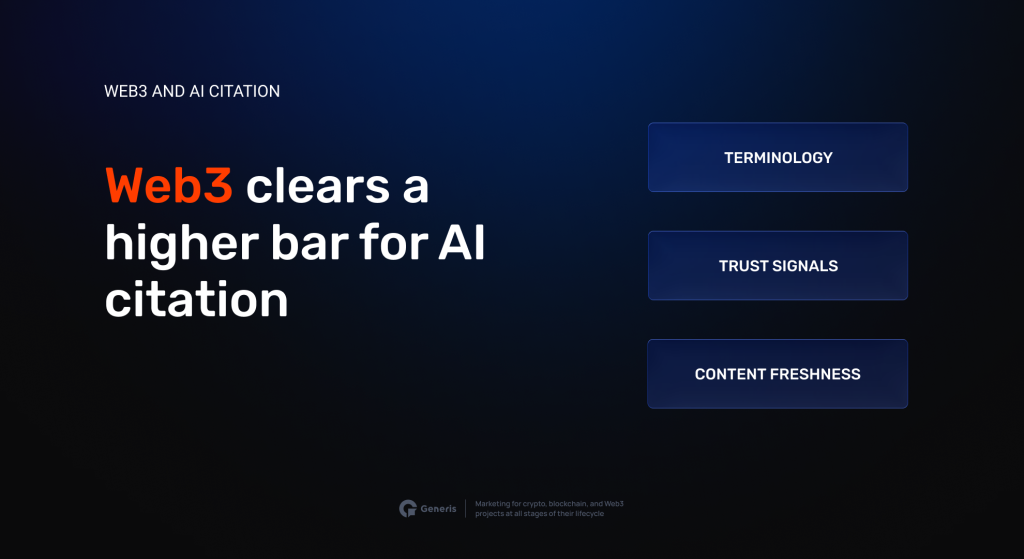
AI search optimization carries particular weight for Web3 and crypto brands. This is a space defined by dense technical jargon, information that changes by the week, and a market that remains fundamentally skeptical of new projects. Getting cited by AI tools in this environment requires clearing a higher bar than most industries.
Web3 brands face a few unique challenges:
- Terminology
Crypto jargon (think liquidity pools, zk-rollups, or restaking) needs to be clearly defined in plain language for AI systems to understand and accurately extract it. - Trust signals
Because the Web3 space has a well-earned reputation for scams and volatility, projects must work considerably harder to establish the authority and trustworthiness signals AI models are looking for. - Content freshness
Fast-moving markets, protocol updates, and shifting regulation mean Web3 content requires far more frequent updates than the average industry to stay accurate and citation-worthy.
At Generis, we build content that does double duty: genuinely educating a skeptical audience while being structurally optimized for AI comprehension and citation from day one. View our cases here.
FAQs About Optimizing Content for AI Search Engines
- Does optimizing for AI search conflict with traditional SEO best practices?
No. AI search optimization builds directly on traditional SEO. The same core principles, including high-quality content, clear structure, and technical accessibility, benefit both disciplines simultaneously.
- How long does AI search optimization take to show measurable results?
It varies by platform. Visibility in Google AI Overviews depends on already ranking on page one, which can take time to achieve. A new, well-structured article, on the other hand, can be surfaced by Perplexity within days of being indexed.
- Can website owners block AI tools from using their content?
Yes. Website owners can use robots.txt directives to block specific AI crawlers. That said, blocking these crawlers may reduce overall brand visibility as AI-powered search continues to grow in adoption.
- Should brands create new content or optimize existing pages for AI search?
Start with your existing, high-performing pages that already rank well in traditional search. Add structured formatting (lists, tables, answer-first sections) to these pages before investing in brand-new content.
- How often should content be updated to maintain AI search visibility?
As a general rule, review and refresh your most important content at least quarterly. Pages covering fast-changing topics, like market trends or emerging technology, will need more frequent updates to stay accurate and relevant.
- Is AI search optimization worthwhile for smaller websites with limited authority?
Absolutely. Smaller sites should focus on niche topics where they can build genuinely deep expertise. Unique, well-structured information can earn citations even against larger, more generalist competitors. AI models reward depth and clarity over sheer domain size.