A Web3 go-to-market strategy is the sequence of decisions a project makes before it spends money on marketing: who the product is for, what makes it different, how that difference gets communicated, and which channels carry that message to the right audience. Most Web3 launches skip straight to channel selection, which is why so many token launches generate a week of noise and then go quiet. This article breaks down a five-phase framework, the GTM-First Framework, that starts with research and ends with growth, so each decision is grounded in the one before it.
Why Most Web3 Launches Fail (Common Crypto Launch Mistakes)
The failure pattern in Web3 is a strategy gap that tactics can’t fix. Three things show up over and over in projects that launch and then stall:
- Weak understanding of the market, the ICP, and the project’s own goals. Teams can describe their product in technical detail but struggle to say who specifically needs it and why that person would choose it over an existing alternative.
- Point-service purchasing after strategic mistakes have already compounded. A project buys a KOL campaign or a PR push to fix a problem that is actually a positioning problem. The tactic executes correctly and still produces nothing because it was never going to solve that layer of the problem.
- Spending that scales before growth does. Budget goes into paid acquisition, influencer packages, or exchange listing fees without a clear read on whether the underlying narrative converts, so the spend just makes a weak message louder.
The common thread: money gets spent on execution before anyone answers the strategic questions execution depends on. That is the gap a go-to-market framework is built to close.
What a Web3 Go-to-Market Strategy Actually Means
Understanding how to build a go-to-market strategy for a Web3 or crypto project starts with a single distinction: go-to-market (GTM) is a coordinated plan for how a product enters a market and finds its audience, built on research and connected decisions.
This is a different starting point from a general marketing plan. A marketing plan typically starts from a channel budget: how much for paid, how much for content, how much for community. A GTM strategy starts from the market itself: who buys, why they buy, what has to be true for them to trust a new project, and only then, which channels reach them. Services like PR, KOL partnerships, SEO, and GEO, community management, and paid acquisition are tools inside that strategy.
Web3 adds three layers that a typical software or consumer launch does not carry:
- Community as a distribution channel and a trust signal at the same time. A crypto community often serves as the mechanism that validates a project to new users before they ever visit the website.
- The token event itself. A TGE (token generation event) or listing is a hard deadline with financial consequences, so GTM timing must work backward from that date rather than forward from a campaign calendar.
- Regulatory exposure. Frameworks like MiCA in the EU shape what a project can legally claim in its marketing, which narrows the range of messaging that a generic consumer GTM playbook would consider safe.
Product-market fit still matters in Web3 exactly as it does anywhere else. What changes is the discovery process needed to find it, and the trust-building work required once you have.
The GTM-First Framework
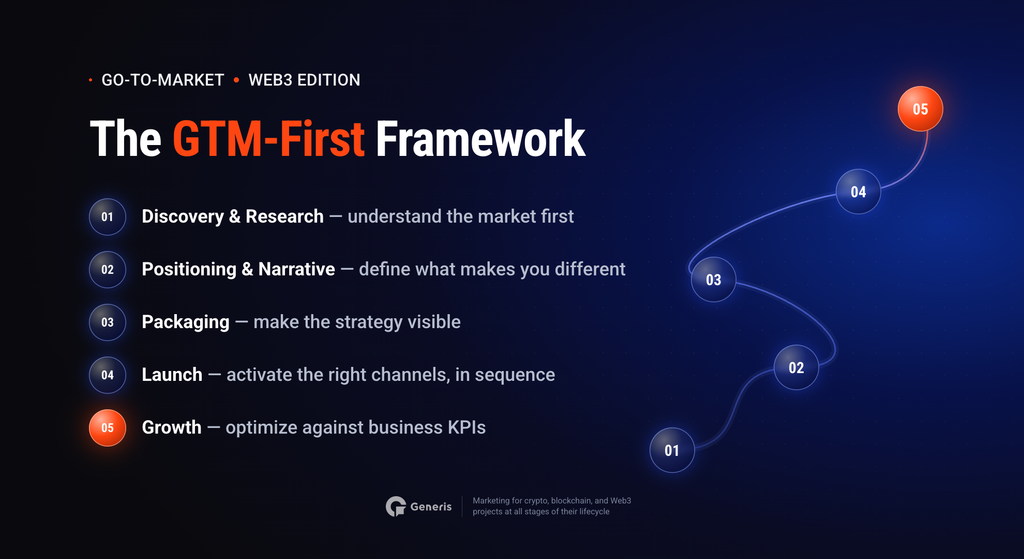
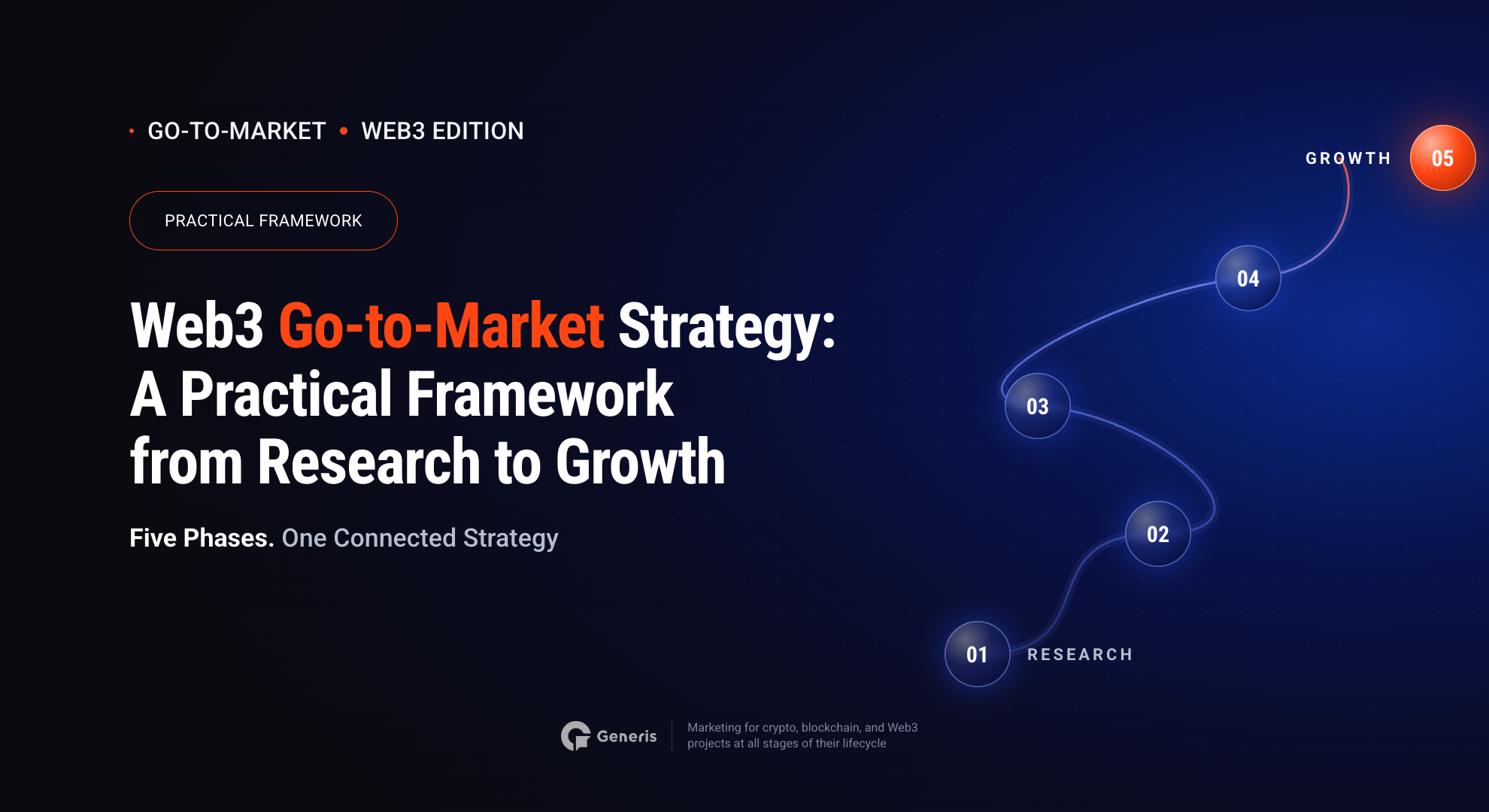
The GTM-First Framework treats go-to-market as a single build and answers how to launch a Web3 token or project step by step without skipping the research that makes later steps work. So what should a crypto go-to-market strategy include? Five connected phases, each producing the input that the next one depends on.
| Phase | Goal | Output |
| Discovery & Research | Understand the market, the audience, and the competitive field | Market and audience insight report |
| Positioning & Narrative | Define what makes the product different and how to say it | Positioning statement and messaging framework |
| Packaging | Make the strategy visible: site, visuals, brand assets | Market-ready and AI-legible brand package |
| Launch | Activate the channels the strategy points to | Coordinated launch across PR, KOL, community, paid, SEO/GEO |
| Growth | Run the ongoing campaign against business KPIs | Continuous optimization tied to on-chain attribution |
Each phase below follows the same structure: a goal, the concrete steps involved, the decisions made, what comes out the other end, and the mistake that most commonly derails that phase.
Phase 1: Discovery & Research
Goal: Build an evidence-based picture of the market, the audience, and the competitive field before any messaging or budget decisions get made.
Key steps:
- Collect competitor data from public sources, covering positioning, pricing, and social presence
- Size the market and identify underserved niches within it
- Run desk research on the target audience: demographics, behavior, and category-specific habits
- Conduct structured interviews with representative users to surface pain points and expectations that desk research alone won’t reveal
- Synthesize findings into a small set of testable insights
Decision points: Which market segment to prioritize first, and whether the audience data supports the assumptions the founding team walked in with. This is also where a project decides if it has one clear ICP or is trying to serve several at once, which changes everything downstream.
Output: An actionable insight report covering market opportunities, audience segments, and where the current competitive field leaves room to differentiate.
Common mistake: Treating research as a formality to get through before the real work of marketing starts. Skipping structured audience interviews in particular, and relying only on assumptions the team already holds, is the single most common gap at this phase.
Phase 2: Positioning & Narrative
Goal: Translate research into a clear statement of what the product is, who it’s for, and why it wins against the alternatives.
Key steps:
- Define the product’s unique advantages and the emotional and functional benefits behind them
- Build comparative positioning against named competitors
- Develop a product profile: core features, competitive comparison, technical aspects, and use cases mapped to specific audience segments
- Stress-test the narrative against objections a skeptical buyer or investor would actually raise
- Lock a single core narrative that every subsequent asset has to trace back to
Decision points: Whether to compete on a specific technical differentiator, a category-defining claim, or a trust/compliance angle, since these require different proof points and different channels later. This is also where a project decides how much of its narrative should target crypto-native users versus a broader or more institutional audience.
Output: A clear market positioning statement and a value proposition that holds up under direct competitive comparison.
Common mistake: Writing positioning that describes the product accurately but doesn’t say anything a competitor couldn’t also claim. Positioning that any project in the category could paste onto its own homepage isn’t positioning yet.
Phase 3: Packaging
Goal: Make the strategy visible and legible to the humans who will evaluate the project and to the AI systems that increasingly summarize it for them.
Key steps:
- Build a Tone of Voice guide and core messaging that stays consistent across every surface
- Design the visual identity: logo, brand style, and a scalable system rather than one-off assets
- Build the website and core content around clear, structured, factual statements rather than vague claims, since this is what both readers and AI-driven search and answer engines extract most reliably
- Write brand guidelines so consistency survives contact with multiple contributors and external partners
- Prepare launch-ready content templates: social posts, email, ad creative, so execution doesn’t stall waiting on design
Decision points: How much visual and messaging flexibility to build in for future markets or product expansions versus locking a tighter, more consistent system now. Also, how directly to write for AI extraction and citation (clear definitions, structured comparisons, direct answers) without making the content read as robotic to a human visitor.
Output: A market-ready brand package: logo, visual system, messaging guide, and core content, built to work for both human readers and the AI layer that increasingly sits between a project and its audience.
Common mistake: Treating packaging as a design task disconnected from positioning. A striking visual identity attached to a fuzzy narrative just makes the fuzziness look more polished.
Phase 4: Launch
Goal: Activate the specific channels the strategy points to, in the sequence and combination that narrative and audience research actually support.
Key steps:
- Select channels based on where the defined audience actually spends attention, not on which channels are cheapest or most familiar to the team
- Sequence PR, KOL partnerships, community activation, paid acquisition, and SEO/GEO so each channel reinforces the others rather than running in isolation
- Set a launch mechanic and timeline that works backward from any hard deadline, a raise, a listing, or a TGE
- Build in a feedback loop so an early signal from one channel can adjust spending on another mid-launch
- Define what “working” looks like before launch day
Decision points: Which channel leads and which supports, since a compliance-heavy RWA or institutional-facing project needs a different lead channel than a community-first consumer token. This is also where a project decides to build versus buy for execution: in-house team, external specialists, or a coordinated mix of both under one strategic owner.
Output: A coordinated, multi-channel launch that executes the positioning built in Phase 2, rather than a set of disconnected activities running at the same time.
Common mistake: Choosing channels first and writing the strategy to justify them afterward. If a project decides it wants a KOL campaign before it decides who its audience is, the channel selection is driving the strategy instead of the other way around.
Phase 5: Growth
Goal: Turn a launch moment into a sustained growth motion, measured against business outcomes rather than activity volume.
Key steps:
- Keep marketing decisions under a single coordinating point rather than letting each channel operate as an independent workstream
- Set KPIs tied to business results (retention, TVL, conversion, funded rounds) instead of vanity metrics like impressions or follower counts
- Build on-chain attribution into the measurement stack, since a large share of Web3 conversion happens on-chain, and off-platform analytics alone will miss it
- Run a regular cadence of what’s working and what isn’t, and reallocate budget accordingly
- Revisit positioning periodically as the market and competitive field shift, rather than treating Phase 2’s output as permanent
Decision points: When to scale a channel that’s converting versus diversifying into a new one, and how much budget stays flexible for reallocation versus committed to fixed programs.
Output: A growth motion with a single point of accountability, measured against outcomes the business actually cares about, with on-chain data feeding the loop.
Common mistake: Continuing to run the launch playbook indefinitely. What gets a project noticed at launch is rarely what sustains it six months later, and projects that don’t revisit the strategy tend to keep spending on tactics that stopped working.
The Framework in Practice
A crypto wallet and messenger project worked with Generis through this sequence ahead of its Launchpad presale and public token sale. Discovery and positioning work shaped a crypto GTM built around influencer marketing, guerrilla marketing, SMM, PR, and Web3 quests, sequenced together rather than run as separate line items.
The launch phase combined a two-stage airdrop campaign with situational influencer content instead of direct ads, which the team found consistently outperformed straightforward promotional posts. The results: $500,000 raised across the Launchpad and public sale, 1.3M+ reach from influencer mentions, 117,865 social media followers, and the token grew 10x within the first 12 hours of listing. The Launchpad itself filled in 9 minutes. Two-thirds of airdrop information shares among influencers were organic rather than paid, and 18,300 users took part in the two-stage airdrop campaign over 7 days.
The pattern worth noting is that PR, influencer marketing, community quests, and social all pointed at the same narrative and launch mechanic, decided in sequence rather than assembled as separate purchases.
Agency vs. Consultant vs. GTM Partner
If you’re asking, should I hire an agency or a consultant for a crypto launch, the honest answer is that it depends on which part of the problem you’re solving. These three models solve different parts of the problem:
- Agency: Executes a defined service, PR, paid media, and content against a brief that the project provides. An agency is strong when the strategy is already clear, and the need is skilled execution against it.
- Consultant: Provides strategic advice and recommendations, typically without executing them. A consultant is useful for a second opinion on strategy or for filling a specific gap in internal expertise, but the project still needs a team to build what gets recommended.
- GTM partner: Builds the strategy and executes it within the same team, deciding what to do and then doing it, bringing in specialists as specific tasks require. Generis operates as this third model: one team owns both the strategic decisions and their execution, rather than handing a recommendation to the client to implement separately. This model matters most for projects that don’t yet have a clear internal answer to “what is our strategy,” since a GTM partner is set up to build that answer and then act on it without a handoff gap between recommendation and execution.
None of these is universally correct. A project with a validated strategy and a gap in execution capacity is usually better served by an agency. A project that genuinely doesn’t know its own market or narrative yet needs strategy work first, whether that comes from a consultant, an internal hire, or a GTM partner that folds strategy and execution together.
When You’re Ready to Start
Two moments consistently mark when a project needs to run this process, rather than defer it further:
- Before a launch, a raise, or a listing. This is the core question of how to market a web3 startup before a raise or listing: once meaningful marketing spend starts, the strategic questions, who the audience is, what the narrative is, and which channels matter, need answers already in place. Working them out after the budget is committed is expensive.
- When money is going out, and growth isn’t coming back. If a project has been running marketing, in-house or through an agency, for months without traction, the issue is rarely that one more campaign will fix it. It’s usually that the direction itself was never validated, and no amount of additional spending against the wrong direction produces growth.
In both cases, the fix is the same: go back to Phase 1 rather than adding another tactic on top of an unresolved strategic gap. Use the five phases above as your web3 GTM checklist: research, positioning, packaging, launch, and growth.
Getting the sequence right matters more for some project types than others. RWA and tokenization projects in particular carry compliance and dual-audience requirements that make Phase 1 and Phase 2 non-negotiable before any channel work starts, which we cover in more detail in our roundup of the best Web3 marketing agencies for RWA projects.
Building this out for a specific project usually raises specific questions faster than a general framework can answer. If that’s where you are, this is what our method looks like in practice, worth a conversation about where your project sits in the sequence.
FAQ
- What does go-to-market mean for a Web3 project?
Go-to-market is the coordinated plan for how a project enters a market and reaches its audience, covering research, positioning, packaging, launch channels, and ongoing growth, built as one connected sequence rather than a set of independent marketing services.
- How long does a Web3 go-to-market take?
Discovery and positioning typically take the longest relative to their apparent size, since audience interviews and competitive research need real time to produce reliable insight. Packaging and launch preparation can often run in parallel with the tail end of positioning work. Total timelines vary widely by project stage and how much foundational research already exists, so treat any fixed number with caution; the sequence matters more than the calendar length.
- Agency vs. consultant vs. go-to-market partner: what does a crypto project need?
It depends on whether the gap is strategic or executional. A project with clear positioning and a defined plan generally needs an agency for execution. A project that hasn’t answered who its audience is or why it wins needs strategy work first, from a consultant, an internal hire, or a GTM partner that combines both under one team.
- When should a crypto project start its GTM?
Before major spend commits, ideally well ahead of a raise, listing, or token launch. Starting go-to-market for crypto projects after a launch date is already fixed limits how much the research can actually change, since some decisions (listing venue, token mechanics, timing) may already be locked.
- How much does a Web3 go-to-market cost?
Cost scales with scope: a narrow positioning and messaging engagement costs meaningfully less than a full discovery-through-launch program spanning research, brand packaging, and multi-channel activation. Projects should treat go-to-market as a strategic investment made before major marketing spend, not as a line item competing with paid acquisition budget for the same dollars.